Wednesday, 4 July 2012

Snow and a (sorta) White Christmas

Before coming to Japan, I had seen snow once at Mt Bulla, in Victoria.  And I'm talking the light-floor-covering snow leftover a full month into Spring.  Imagine my delight then when one day in December while I was at school, it started snowing!

I didn't have class at the time and so was sitting at my desk in the staffroom as my teachers started calling me over to the window, "look, look Naomi-sensei, it's snowing." For a while I just stood there at the window mesmerised by the falling flakes, but then the kid inside me took over and I ran outside with my camera to stand in the snow and take pictures.  And what did I think of my first real encounter with snowing weather?  I thought it was bloody cold!


This is the view of the front oval, from the staffroom at one of my Elementary Schools.


This is the partially snow-covered courtyard playground at the same school.


Apparently it only snows in Awa City 5 or 6 times per winter, but when it does it's because the temperature has dropped significantly.  Having come from relatively mild winters (yes, even including the storm lashings that we lived through right opposite the beach during a St Kilda winter) I was in no way prepared for the briskness of a Japanese winter.  And in winter, Japan is cold everywhere, except bed!


A snowy farm yard nearby my apartment.


While it was snowing outside, for example, every student (and teacher) had to participate in 20-minutes of morning jogging and every classroom window at my school was inexplicably left open all day.  The staffroom was heated with an old-school kerosene heater, with my Primary School classrooms only running this kind of heating too.  My apartment, like many others, does not have insulation or carpet and so being at home was mostly freezing too.

I also experienced the joys of a frozen windscreen for the first time this winter and in trying to figure out how to deal with the problem, made myself late for school.


Luckily the snow doesn't stick for very long in Awa though and usually a half-day was all it took for the snow to melt away again.  There wasn't too much drama on the roads because of this, though I know some colleagues who live with the very real threat of becoming snowed in either at school or at home.


Waking up to see snow outside my apartment.


Half a day later, it's gone!


Despite the fact that I couldn't wipe the smile off my face every time it snowed in that first Japanese winter, celebrating Christmas in the cold hit me hard.  It was so strange to be rugging up and cooking a full roast dinner on December 25th.  I spent most of the day dreaming about summer dresses and cold beers, sausages on the barbecue and ice-cream cassata for dessert, paddling in the pool and passing out on the couch under the airconditioning!  I did crank my heaters up to the blisteringly hot setting and try pretending I was living an Aussie Christmas but it just wasn't the same!


Vending Machines

I know what vending machines are right?  We have them in Australia, so what, big deal...  Well, the deal is this: in Japan they are EVERYWHERE!!!  In this country you'll drive past a vending machine every 500-metres, you'll see them in every shopping complex and most apartment buildings have one downstairs.  And, not happy happy standing alone, most vending machines huddle together to form a bank of vending machines - ensuring that you're able to purchase just about any drink your heart could desire at any time of the day or night!  This is particularly handy during summer when it's amazingly hot and humid or at night-time when you're halfway through a bottle of scotch and run out of Coke.

Drinks usually range from 100yen (approx 1.25AUD) for a standard bottle of water to 150yen (2AUD) for 700ml Coca-Cola or Aquarius Sports Drink.  You can also buy Japanese tea in a bottle, milk tea in a can, many different types of coffee in a can, grape-flavoured Fanta, naturally flavoured waters, juices and Solo etc.

But it's not just cold beverages that you can get from vending machines in Japan...  I personally have seen machines that will give you hot cans of tea or coffee, machines that dispense ice-creams, vending machines that sell packets of rice, egg vending machines (where you can buy a 10-pack, or standard Japanese sized, carton of eggs), cup noodle machines, cigarette machines and even alcohol (sake, beer etc) vending machines!


This is a typical drink vending machine, at a temple in Kochi prefecture.


This vending machine is selling batteries, disposable cameras and other small electronic goods.


How I'll survive without them when I get back to Australia, I don't know.

Whitewater Rafting

Anyone who knows me can attest to the fact that I am about as far from being a waterbaby as possible, but at the end of my first Japanese summer I decided to take the (what turned out to be quite literal) plunge and signed up for Whitewater Rafting.

A large group of us settled on a date to go; reservations were made, what-to-bring lists were circulated and google map directions were sent.  And then it rained.  Heavily.  And the whole venture was on the brink of being cancelled due to dangerously high water levels (producing harsher rapids) in the river.  Luckily, by the Sunday morning the conditions had improved and it was deemed safe to enter the water.

Carload by carload we all arrived at Happy Raft ready to roll.  As one of the first to arrive, I spent some time chatting with the owner, Mark (a fellow Aussie from Brisbane) about my mild water phobia and jokingly requested a pair of floaties to wear on the trip.  Mark assured me everything would be fine and that once the adrenaline kicked in I'd have the time of my life...

With everyone managing to find the place and gather, the next thing to check off the list was our insurance paperwork.  I had no problem answering the medical questions and waiving indemnity, but I have to admit I did write a little note at the bottom - alongside my Mother's contact details - stating that in the case of emergency they should pack me up and send me home to Australia ASAP!!

Paperwork complete, we listened to some brief instructions and then filed downstairs to find a wetsuit, life jacket and helmet.  I managed to squeeze into a nice little khaki green wettie, secure my life jacket with rib-squeezing surety and nab a funky red helmet to wear.  Next we were given some white sticker labels and a marker and told to come us with "rafting names" for ourselves.  Someone in our group suggested animal names and such is how I landed the moniker "Monkey" for the rest of the day.


This is my Britsh friend Austin (aka Icarus) and I before heading into the water!


Finally we were ready to drive upstream to the start of the rafting course and so all 30-odd of us climbed into the bus, rafting paddles in hand.  A 10-minute ride later and we were there, all too busy deciding how to arrange ourselves in groups to pay much attention to the rapids surging in the river down below.  Mark kindly allocated himself as my group's guide (I think to make sure I didn't end up drowning myself accidentally) and I hopped into a raft alongside Samantha (from NZ), Bella (from the UK), Robert (from Germany), Liz (also from the UK) and Sarah (a fellow Aussie).  Not the biggest, strongest or most athletic of groups but a fun bunch nonetheless.


My rafting group: (L-R) Bella, Sarah, Samantha, Robert, Liz, me and Mark.


Taking our first rapid shortly after setting off was an exhilarating (read: scary) experience but Mark was right, I'd have fun once the adrenaline started pumping.  Pretty soon we were hitting rapid after rapid and having a blast.  A quiet part of river gave Mark the opportunity to teach us the secret skill that's absolutely essential when rafting: effectively using your paddle to splash the other group's rafts as they float by.  Needless to say, shortly thereafter the 'water wars' began and in addition to navigating the whitewater we were also concentrating on staying as far away from the other rafts as possible (unless of course we were planning a sneak attack).

Halfway through the morning's rapids, we pulled up alongside a rather large though easily climbable rock and were given the chance to get up there and jump off.  Most people had no problem climbing up the (maybe) 5-metre high rock and launching themselves off the top.  Bella was a tad shy about the whole thing and after spending an entire 10 minutes at the top lamenting her ascent up the rock, was dragged into the water by Mark to a thunderous round of applause.  Highly amusing.

Frolicking over, we all jumped back into the rafts and took off for the second leg of the morning trip, posing for photographs taken by some Happy Raft guys on a nearby bank.

Eventually we made it back to the Happy Raft base and beached our rafts in search of lunch.  I'd heard about the bagel lunches put on by Happy Raft and had been told that they were amazing.  I admit to being a little skeptical - I mean, how good could a bagel possibly be?  Turns out, pretty bloody amazing.  Freshly baked bagel buns, cream cheese spread, tuna, sliced ham, lettuce, tomato - we each made and ate as many bagels as our restricting wetsuits would allow.  Another 30 minutes for lunch to settle/photos to be taken and we were off again down to the river for round two.

The afternoon raft was a bit calmer than the morning stint and we even got a chance to swim in the river on the way down.  A few of us girls made a chain and went down some small rapids sans raft.  I was surprisingly content with swimming in the river, that is until someone mentioned it's a famous eel fishing spot!  Back into the raft for me, where the 'water wars' had escalated into people diving from raft to raft in an attempt to conquer.  We also had a go at holding the raft up on its end in the water - which required everyone to work together in perfect harmony so as not to upset the balance.  Unfortunately, I thought one of the group was about to bail and so myself let go of the rope, causing the whole raft to tip upside down and throwing my fellow group members into the water.  Oops.


Attempting to tip the raft on its end (just before I bailed, bringing everyone down with me!).


By the time we got to the next big rock platform many of us were no longer in the mood to jump.  Plus, this rock was MUCH bigger than the last one, standing at a good 10-metres tall.  A brave few clambered up though and one by one took turns pin-dropping into the water below.  I decided to have a go after all, though after getting to the top I immediately began looking for ways to climb back down again.  It's when you're standing right on the top that you realise just how high it is.  Not to be outdone by fear however, I took the leap (rather awkwardly, I must admit) and hit the water at a strange and unusual angle at the bottom.  First thing I did was check for mobility in all my limbs, tilt my head side-to-side to make sure my neck still worked and then began coughing and spluttering from all the water I'd managed to swallow.  Everyone who had seen my drop was asking me if I was alright and truthfully I think I did give myself a bit of concussion (I certainly was a little afraid to fall asleep later that night!).  Nothing as bad as what befell Liz though, who managed to take a paddle to the face, splitting open her eyebrow and bleeding profusely all over the raft.  After a hasty patch-up attempt, Liz was all bandaged up and were set off on the last half hour of our trip along a section of river that mostly allowed for serenely floating down in our rafts.

The bus was waiting for us when we got to shore and as it was now roughly 4pm we climbed back on board and headed back to Happy Raft to shower, change and check out our pics.  By the time we'd packed up and headed home, I ended up calling it a night pretty early, completely plum-tuckered out by the adventure.

Tuesday, 3 July 2012

Shoes On, Shoes Off, Shoes On...

As a girl with a certified shoe addiction, I was devastated to learn that in many places in Japan you cannot wear your 'outdoor shoes' indoors.  This unfortunately meant that the 30-odd pairs of high heels I crammed into my suitcase and brought over with me, are relegated to merely decorating my shoe closet most of the time.


This is my shoe shelf, just inside the front door of my apartment.


At school for example, teachers and students each have their own shoe lockers with a pair of "indoor shoes" snuggled inside.  When you arrive at school in the morning, you stand on a rubber mat near the aforementioned shoe lockers and remove your outdoor shoes.  You then step into your indoor shoes and place the originals into the locker for the day.  I assume this is in order to make cleaning the floors an easier task, though conceivably it could also be to prevent damage to the hardwood floors that feature heavily throughout the school, or to distinguish between students of different year levels (1st grade JHS students at my school wear white shoes with blue trim, 2nd grade students wear white shoes with yellow trim and 3rd grade students wear white shoes with green trim).


This is my shoe locker at school.


Depending on where you go that day, it's not uncommon for people to change shoes dozens of times from the moment you leave the house to the moment you return.  It is common practice to take your shoes off and stack them on a provided shelf at restaurants for example.  Also, in Japan people never wear shoes inside personal homes.  If you are visiting someone, you will be expected to take your shoes off just inside the front door (usually you are presented with house slippers to wear).  It is also common practice for women to wear stockings ALWAYS or these little footlet socks that come in a variety of colours/materials.


This is my shoe situation on any given day:

1.  Put on my "outdoor shoes" as I leave my house.

2.  Drive the 3 minutes it takes me to get to school, enter the foyer and change into my "indoor shoes".

3.  Wear indoor shoes all day at school, except when I have to use the bathroom - at which time I must take off my indoor shoes and step into "bathroom slippers".

4.  Change back into my "indoor shoes" at the conclusion of my bathroom visit and remain in these shoes UNLESS... I have to go to the gymnasium, in which case I must change into "gym slippers" for the duration of my stay in there.

5.  Exit the gym and change back into my "indoor shoes" to go back to the staff room.

6.  At home time I go back downstairs to the foyer, remove my indoor shoes and place them in my locker, step into my "outdoor shoes" again and drive the 3 minutes home.

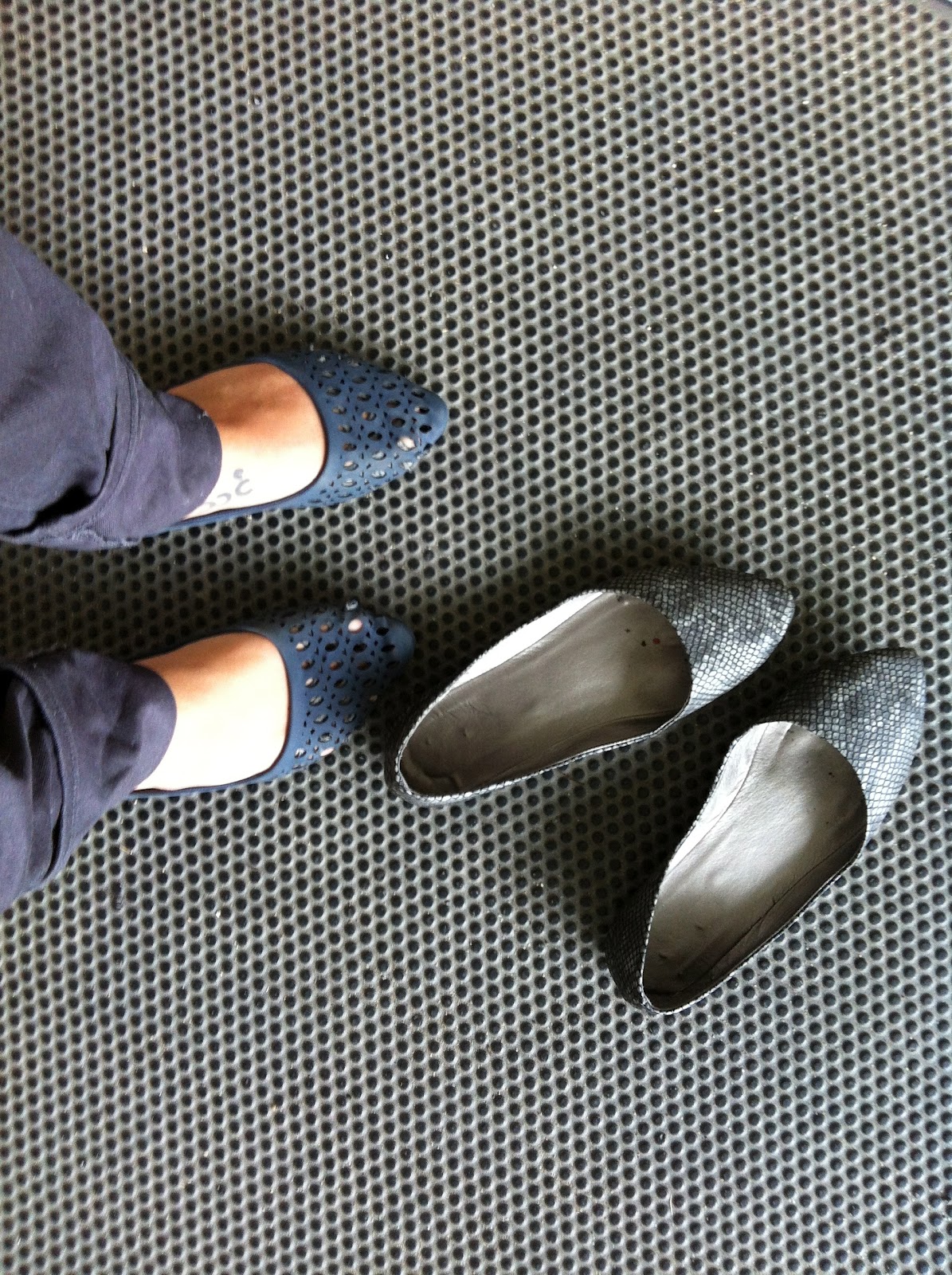
7.  Arrive home, step inside and remove my "outdoor shoes" altogether.

This has become my daily shoe routine, save for travelling anywhere or visiting anyone etc, in which case the number of shoe changes increases again!  Crazy huh?


Here I am wearing my "indoor shoes".  As it is the end of the school day, I must change into my "outdoor shoes" to wear home.


Every school has a supply of "visitor slippers" for guests that come to the school.


This is the entryway to my apartment, where all my shoes get lined up after being taken off.


The Iya Valley

When you think of Japan you might picture flashing neon lights, surging crowds and amazing technology...  You'd be forgiven because before arriving here this is exactly how I pictured Japan too.  Unfortunately in my neck of the woods (rural Japan, also known as "the inaka" or countryside) none of these enduring images is particularly true.  Some would argue that to make up for Tokushima's relative lack of "metropolitan life" it is bestowed with some of the most beautiful natural scenery in Japan.  In search of these wonders of nature, Phil and I journeyed into the west of the prefecture and scoped out the Iya Valley.

The Iya Valley is famous for it's mountains (Mt Tsurugi being the tallest) and gorges (you can even go white water rafting in Oboke Gorge).  It is also home to a few famous vinebridges that date back to Samurai times - though I suspect the steel reinforcement to be a recent addition.  And if you're feeling brave, there is also a Zorbing Centre where you can climb into a puddle of water in the middle of a giant rubber ball and be pushed down the side of a small custom-made, totally-safe mountain track.

Here are some pictures from our day in the Valley:


This is the Iya Vinebridge.  For a small fee (400yen or so) you can walk across this bridge.  The bridge is renovated every 4 years.


For those not game enough to cross (note: you CAN see through the slats on the bridge to the rocks and river below), there is a viewing platform on a regular bridge some 50 metres away.


High up in the Iya Mountains, you can see Manikin Piss Boy.  This statue of a cheeky boy symbolises courage as the sheer drop on the other side of the boy falls hundreds of metres into a ravine.


This is me giving "zorbing" a try for the first time.  For 700yen (about 10AUD) you are given a change of clothes and set tumbling down the hill in a rubber ball.  Inside you slide around in about 20 litres of water - getting completely drenched by the bottom!

School Lunches

In Japan, students and teachers subscribe to a school lunch, called "kyushokyu".  Every day, this meal is cooked offsite and delivered to the school in heavy duty metal containers.  Each class (and the staffroom) gets its own allocated portion of food along with accompanying lunch trays, plates, bowls, chopsticks or sporks and a carton of milk per person.

At lunchtime designated members of class don aprons, hats and face masks before collecting the lunch order for their group.  Trays are laid out, food is divvied up and then you sit at your desk and eat it.  Generally, you must finish your lunch and restack your plates/bowls/tray before you are allowed to go anywhere/do anything else at lunchtime.

Initially, I signed up for school lunches at Awa Junior High School (at a cost of about 80AUD per month) but after a dreadful September menu, I cancelled my order and mostly go lunchless at school now.  I have maintained an order for Wednesday's at Elementary School though, as I find the lunches made for the little kids to be a bit more palatable to the Western tastebud.

Check out some of the lunches I've eaten so far:


This is one of the better school lunches, featuring: beef curry, white rice, fruit salad and a carton of milk.


This school lunch was ok: grilled fish, beef and potato miso soup, white rice, frozen pineapple chunk and a carton of milk.


The beef patty in this school lunch made the vegetable soup and pickled cucumber/cabbage bearable.


This is what losing the school lunch lottery looks like: mini raw fish and seaweed salad, pumpkin and seafood stew and rice ice-cream - WTF?


Sometimes the staff receive special bento boxes (lunch boxes) for school lunch.  This usually happens if we have to work on the weekend or for a special occasion.  This bento box was in honour of Setsubun Festival - a day when setsubun beans (the purple beans cooked into the rice) are thrown at "a demon" to try and scare bad luck away.


This is why Elementary School lunches rock - exhibit A.  Cream Stew (almost like Chicken Fricasee), fried rice and an omelette alongside the ubiquitous carton of milk.


Another school lunch win: mince and tofu stew, fried gyoza (Chinese dumplings), white rice, yakult yoghurt drink and a carton of milk.


Spaghetti bolognaise, a bread roll, pickled vegetable, a cup of Japanese tea and a carton of milk.


One of the best school lunches I've ever had: pizza toast, tuna and vegetable salad, creamy pumpkin soup and a carton of milk.


A recent elementary school lunch win: fresh slices of bread, plastic cheese, vegetable patty, pickled cabbage and tomatoe sauce (used to make a burger) with egg/beef soup, a mandarin and a carton of milk.


Purikura

One of my favourite things in Japan would have to be these arcade photobooths that you can find at (just about) every shopping centre.  These are called Purikura Booths and you can get souvenir photos from them.  For 400\ you and your friends can step inside the booth and have the opportunity to strike between 4-8 poses.  The camera will wait roughly 20 seconds between pictures, giving you ample time to organise yourselves and practise your smile.

After you have finished the picture taking, the fun really begins.  You head around to a little alcove on the side of the machine where your pictures come up on a screen.  You and a friend can use the touchscreen and attached pen to alter, edit and decorate your photographs.  You can choose to change the background, add cartoon characters/stars/hearts, write your name or a message in Japanese or English, give each other moustaches/glasses/different coloured hair/hats or giant eyes, and then decide which photos you want to accentuate on the print sheet.

Once you've finished fiddling with your photos onscreen, you have the option of sending a copy to your mobile phone's email address - but you have to be quick, most option screens work on a countdown timer and if you're not done in 30 seconds, too bad!

Finally, your photos will print and each booth usually spits out 2 sets of picture cards for you to take home.  Some machines I have been to though allow you to choose how many people require copies, so that everyone can take a sheet home.

Having purikura pictures taken is really popular in Japan and definitely so with my friends.  It is  common to get visit a purikura booth when you are on holidays, have gone somewhere different or for special occasions.  I personally collected purikura when I've holidayed in Osaka, Nagoya, and Sapporo or when I visited Matsuyama, Takamatsu and Kobe with my friends - have a look at a few!


This purikura was taken when Phil and I visited Matsuyama with our friends Erin and Brian.


This is from when I spent a weekend in September partying with my Melb friend Jarryd in his city, Kobe.


Purikura from Nagoya (when we visited for the Suzuka F1 2011).


Christmas-shopping-in-Takamatsu-with-Lisa purikura.


Sapporo Snow Festival purikura with the girls (Liz, Danielle and Dinah).


Purikura with Harry.